• Crypto
    • Bitcoin
    • Ethereum
    • Altcoins
    • Cardano
    • Solana
  • Web 3
    • Metaverse
    • NFT
  • Blockchain
  • Analysis
  • Learn
  • AI & VR
  • Gaming
  • Marketcap
  • Shop
What's Hot

Is Staking Crypto Safe? What You Should Know Before Staking

September 15, 2026

What Is the CLARITY Act and What Does It Mean for Crypto?

September 14, 2026

What Is Cross Margin in Crypto? How It Works, Risks, and Examples

September 14, 2026
Facebook Twitter Instagram
  • Contact
  • Disclosure
  • Privacy Policy
  • Terms & conditions
Facebook Twitter Instagram
VIP Crypto Signals
  • Crypto
    • Bitcoin
    • Ethereum
    • Altcoins
    • Cardano
    • Solana
  • Web 3
    • Metaverse
    • NFT
  • Blockchain
  • Analysis
  • Learn
  • AI & VR
  • Gaming
  • Marketcap
  • Shop
VIP Crypto Signals
Home » Blog » New research shows how brain-like computers could revolutionize blockchain and AI
AI & VR

New research shows how brain-like computers could revolutionize blockchain and AI

July 25, 2023No Comments3 Mins Read
Share
Facebook Twitter LinkedIn Pinterest Email

Researchers from Technische Universität Dresden in Germany recently published breakthrough research showcasing a new material design for neuromorphic computing, a technology that could have revolutionary implications for both blockchain and AI.

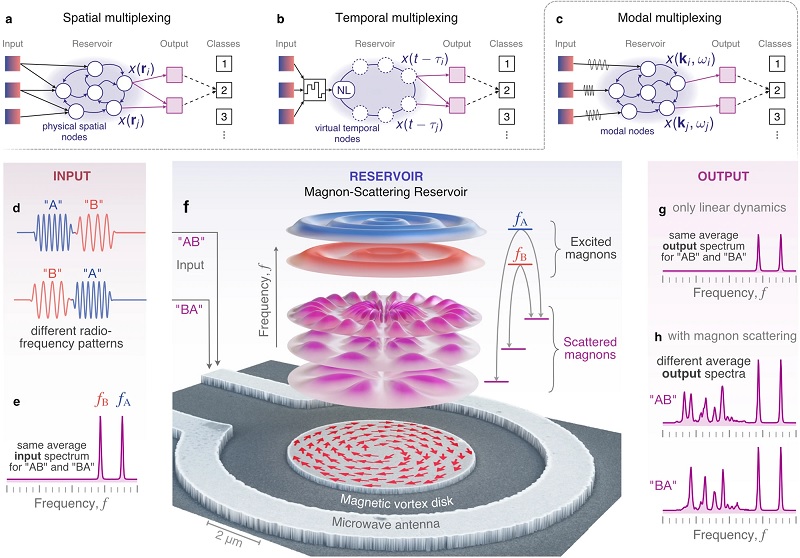
Using a technique called “reservoir computing,” the team developed a method for pattern recognition that uses a vortex of magnons to perform algorithmic functions near instantaneously.

Working principle of a magnon-scattering reservoir. Source: “Pattern recognition in reciprocal space with a magnon-scattering reservoir,” Nature

Not only did the researchers develop and test the new reservoir material, but they also demonstrated the potential for neuromorphic computing to work on a standard CMOS chip, something that could upend both blockchain and artificial intelligence (AI).

Classical computers, such as the ones that power smartphones, laptops and the majority of the world’s supercomputers, use binary transistors that can either be on or off (expressed as either a “one” or “zero”).

Neuromorphic computers use programmable physical artificial neurons to imitate organic brain activity. Instead of processing binaries, these systems send signals across varying patterns of neurons with the added factor of time.

The reason this is important for the fields of blockchain and AI, specifically, is because neuromorphic computers are fundamentally suited for pattern recognition and machine learning algorithms.

Binary systems use boolean algebra to compute. For this reason, classical computers remain unchallenged when it comes to crunching numbers. However, when it comes to pattern recognition, especially when the data is noisy or missing information, these systems struggle.

This is why it takes a significant amount of time for classical systems to solve complex cryptography puzzles and why they’re entirely unsuited for situations where incomplete data prevents a math-based solution.

See also  OpenAI seeks to diffuse internal tensions after Altman departure: Report

In the finance, AI and transportation sectors, for example, there’s a neverending influx of real-time data. Classical computers struggle with occluded problems — the challenge of driverless cars, for example, has so far proven difficult to reduce to a series of “true/false” compute problems.

However, neuromorphic computers are built for dealing with problems that involve a lack of information. In the transportation industry, it’s impossible for a classical computer to predict the flow of traffic because there are too many independent variables. A neuromorphic computer can constantly react to real-time data because it doesn’t process data points one at a time.

Instead, neuromorphic computers run data through pattern configurations that function somewhat like the human brain. Human brains flash specific patterns in relation to specific neural functions, and both the patterns and the functions can change over time.

Related: How does quantum computing impact the finance industry?

The main benefit of neuromorphic computing is that, relative to classical and quantum computing, its level of power consumption is extremely low. This means that neuromorphic computers could significantly reduce the cost in terms of time and energy when it comes to both operating a blockchain and mining new blocks on existing blockchains.

Neuromorphic computers could also provide significant speedup for machine learning systems, especially those that interface with real-world sensors (self-driving cars, robots) or those that process data in real-time (crypto market analysis, transportation hubs).

Collect this article as an NFT to preserve this moment in history and show your support for independent journalism in the crypto space.

Source link

See also  David Schwartz to Unveil Blockchain Interop Plans at ETH Denver
Blockchain brainlike Computers Research Revolutionize Shows
Share. Facebook Twitter Pinterest LinkedIn Tumblr Email

Related Posts

Proof of Play to shut down after blockchain gaming thesis falls short

August 5, 2026

How to Research a Crypto Coin Before You Buy (2026 Guide)

July 17, 2026

Hur Blockchain och NFT-teknologi Förändrar Kasinobranschen för Alltid

June 29, 2026

YOM Joins the Blockchain Game Alliance Alongside Ubisoft and Animoca Brands

May 24, 2026
Add A Comment

Leave A Reply Cancel Reply

Top Posts

Is Staking Crypto Safe? What You Should Know Before Staking

September 15, 2026

What Is the CLARITY Act and What Does It Mean for Crypto?

September 14, 2026

What Is Cross Margin in Crypto? How It Works, Risks, and Examples

September 14, 2026

Subscribe to Updates

Get the latest news and Update from VIP Crypto Signals about Crypto, Web3, Metaverse, NFT and more.

Our mission is to develop a community of people who try to make financially sound decisions. The website strives to educate individuals in making wise choices about Cryptocurrencies, NFT, Metaverse and more.

We're social. Connect with us:

Facebook Twitter Instagram Pinterest YouTube
Top Insights

Is Staking Crypto Safe? What You Should Know Before Staking

September 15, 2026

What Is the CLARITY Act and What Does It Mean for Crypto?

September 14, 2026

What Is Cross Margin in Crypto? How It Works, Risks, and Examples

September 14, 2026
Get Informed

Subscribe to Updates

Get the latest news and Update from VIP Crypto Signals about Crypto, Web3, Metaverse, NFT and more.

Facebook Twitter Instagram Pinterest
  • Contact
  • Disclosure
  • Privacy Policy
  • Terms & conditions
© 2026 Vip Crypto Signals - All rights reserved.

Type above and press Enter to search. Press Esc to cancel.

  • FibSwap DEXFibSwap DEX(FIBO)$0.0084659.90%
  • bitcoinBitcoin(BTC)$70,953.006.13%
  • ethereumEthereum(ETH)$3,664.5818.50%
  • tetherTether(USDT)$1.00-0.01%
  • binancecoinBNB(BNB)$627.698.99%
  • solanaSolana(SOL)$181.131.69%
  • staked-etherLido Staked Ether(STETH)$3,662.5418.48%
  • usd-coinUSDC(USDC)$1.00-0.02%
  • rippleXRP(XRP)$0.545.05%
  • dogecoinDogecoin(DOGE)$0.1634778.14%