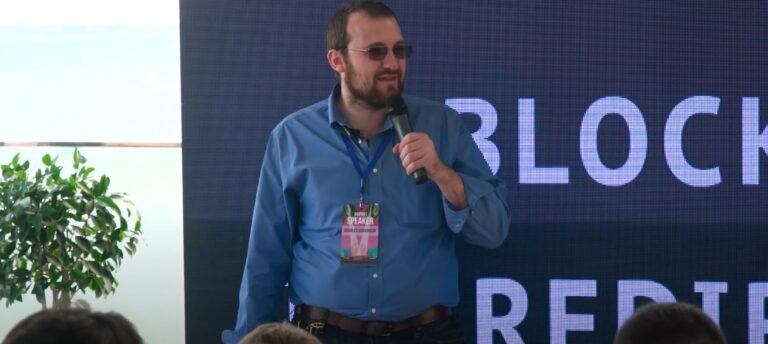
On the sidelines of the TOKEN2049 event in Singapore, Charles Hoskinson, Co-founder and CEO of Input Output (IOHK), discussed the future of cryptocurrencies, focusing on the next generation of digital assets and their path toward mainstream adoption. During the interview with Bloomberg TV’s Annabelle Droulers, Hoskinson outlined the evolution of the cryptocurrency space, the major challenges still to be addressed, and how Cardano fits into the larger crypto ecosystem.
Hoskinson began by explaining that the industry is currently in the “middle part of the third generation of cryptocurrencies.” He categorized the progression of the crypto space into four distinct generations. The first generation was Bitcoin, which introduced the concept of decentralized digital currency. The second generation was Ethereum, which brought programmable smart contracts to the forefront. The third generation, represented by platforms like Solana, Cardano, Tezos, and Polkadot, focuses on tackling scalability, governance, and interoperability challenges. He emphasized that while significant progress has been made in governance and scalability, the two remaining hurdles for “trillions of dollars” of real-world assets to flow into the space are privacy and identity.
These two issues, privacy and identity, are crucial for mainstream adoption because they enable regulation and dispute resolution. For example, identity mechanisms would allow users to recover their crypto in the event of a lost key, while privacy enables businesses to maintain confidentiality in areas such as medical records, contracts, and other sensitive data. According to Hoskinson, once privacy and identity are fully addressed, cryptocurrencies will have the infrastructure necessary to bring “the next billion people into the cryptocurrency space” by 2025 or 2026.
Turning to Cardano, Hoskinson highlighted the unique aspects of the blockchain’s journey. Cardano, which started in 2015, is now deep into the third generation of crypto, focusing heavily on scalability, interoperability, and governance. Hoskinson noted that governance has been a significant focus for the past two years, with Cardano actively working on building decentralized governance structures. This is a challenging process that requires coordinating people from more than 100 countries to create an on-chain constitution and establish fair representation in decision-making.
He explained that governance in the blockchain space is fundamentally different from traditional product management models. In centralized systems, such as Apple with the iPhone or Microsoft with Windows, the company has full control over the development and direction of its products. In contrast, decentralized systems, like Cardano, require the holders of the protocol to participate in governance decisions. This decentralized governance model is complex, especially when trying to align people from diverse cultures and regions, but it is essential for creating a sustainable, long-term ecosystem.
Hoskinson went on to explain that the decentralized governance structures Cardano has built are not just theoretical. He pointed to Midnight, a project within the Cardano ecosystem focused on creating private smart contracts and integrating identity. This project is aimed at addressing the “last mile” for business adoption by enabling automated regulation and secure business interactions. Hoskinson stressed that privacy and identity will be pivotal in making cryptocurrencies more business-friendly, allowing companies to adopt blockchain technology with confidence.
When asked whether Cardano’s unique decentralized governance structure is a positive or negative for institutional adoption, Hoskinson firmly stated that it is a “massive positive”. He explained that decentralized governance brings consistency and reliability to the ecosystem, which is crucial for institutions. Using the collapse of FTX and its former CEO Sam Bankman-Fried as an example, Hoskinson argued that centralizing too much power in the hands of one individual or organization can lead to disastrous consequences. In contrast, a decentralized model ensures that no single actor has too much control, creating a more resilient system.
He likened the governance model of Cardano to the Linux Foundation, where hundreds of companies and members come together to work in common interest. In this setup, even competing companies such as IBM and Microsoft can collaborate to support the broader ecosystem, thanks to the stability and fairness of the governance structure. Hoskinson underscored that this kind of consistency is what governments and institutions require before they adopt blockchain technology. No nation-state, he argued, would implement a voting system or any other critical infrastructure on a blockchain unless it can trust that the system will be around for the long term and is governed in a fair and efficient manner.
As the interview progressed, Droulers raised the issue of competition between different blockchains, particularly between Cardano and Solana. Hoskinson responded by suggesting that the fourth generation of cryptocurrencies will bring greater collaboration between blockchains. He believes that multi-resource consensus models will allow staking rewards to be paid across multiple blockchains, creating a financial incentive for these networks to work together rather than compete. In Hoskinson’s view, financial incentives are key to fostering partnerships between different blockchain ecosystems. He remarked that “people have to see emergent value in relationships”, and that the current tokenomics of many cryptocurrencies create a competitive, rather than cooperative, atmosphere.
Looking back at the industry’s growth, Hoskinson expressed amazement at how quickly the space has evolved, remarking that in just 15 years, the industry has grown from one person building Bitcoin to a “gargantuan $450 billion to $2 trillion industry.” He attributed this rapid growth to the decentralized coordination that is inherent in blockchain technology, emphasizing that the future of the space will depend on further developing these coordination mechanisms.
Droulers also raised the issue of token dilution, mentioning that millions of new tokens had been issued in 2024 alone. Hoskinson acknowledged that this could be a challenge but expressed confidence in Cardano’s long-term value proposition. He emphasized that Cardano has one of the most loyal and evangelistic communities in the space. He pointed out that Cardano’s decentralized governance structure, with its $600 million treasury, will soon allow the community to make strategic investments to promote growth. Unlike other projects that have experienced “ephemeral” growth driven by large foundations giving themselves billions of dollars, Cardano’s growth is rooted in deep, long-term philosophical beliefs held by its community.
Hoskinson closed the interview by reflecting on how, much like early Bitcoin enthusiasts, the Cardano community is not just in it for the money but is deeply invested in the vision and message of the project. He noted that many Cardano supporters were there when ADA was worth just a few cents and continue to support the network regardless of the token’s value, which demonstrates the enduring belief in the project’s potential.