Five years ago, Brian Frye set an elaborate trap. Now the law professor is teaming up with a singer-songwriter to finally spring it on the SEC in a novel lawsuit—and in the process, prevent the regulator from ever coming after NFT art projects again.
Earlier this week, Frye and musician Jonathan Mann filed a federal lawsuit against the U.S. Securities and Exchange Commission that seeks to finally force the agency to articulate its position on the legal status of NFTs. Over and again, the SEC has sued cherry-picked NFT projects it says qualify as unregistered securities—but never once has the regulator defined what types of NFT projects are legal and which are not, casting a chill over the nascent industry.
The offbeat saga of this week’s lawsuit begins in 2019, when Frye, an expert in securities law and a fan of novel technologies, minted an NFT of a letter he sent to the SEC in which he declared his art project to constitute an illegal, unregistered security. If the conceptual art project wasn’t a security, Frye challenged the agency, then it needed to say so.
The SEC never responded to Frye—not then, and not after several more self-incriminating correspondences from the professor. But in due time, the agency began vigorously pursuing, and suing, NFT projects.
I’ve been writing a song a day for 16 years and 211 days.
Today, I’m suing the SEC.
(Yes, this is real) pic.twitter.com/QubAgbltr0
— 16 years of song a day (@songadaymann) July 29, 2024
Last September, when the regulator came after actress Mila Kunis’ NFT-based cartoon series Stoner Cats, many artists who depend on revenue from NFT sales became concerned. Jonathan Mann, a musician who has written a new song every day since 2009, was one such artist. But he wasn’t just concerned—he was outraged.
“Any time I talk to the Stoner Cats people, or other people who have been affected [by the SEC], steam comes out of my ears,” Mann, better known as “Song A Day Mann,” told Decrypt. “I physically feel angry.”
Stoner Cats, an animated web series developed by Mila Kunis that featured the vocal talents of several A-list actors and Ethereum creator Vitalik Buterin, sold NFT passes required to view the program. Stoner Cats’ creators ultimately reached a $1 million settlement with the SEC without admitting wrongdoing, but the suit all-but killed the project, as well as another NFT-powered series backed by Kunis.
The same day as the Stoner Cats settlement, Mann posted a new tune entitled “This Song is A Security.” (He’s a quick writer.) Mann resolved at that moment to fight back against the SEC, and defend his right—plus the rights of other artists like him—to earn revenue through the sale of NFTs. That would involve voluntarily poking his head out of the ground and challenging the agency head-on, despite the fact that the Commission hadn’t sued him yet. But Mann felt like he had no other choice.
“No one wants to be under the eye of the SEC,” he said. “But I feel like our cause is so righteous, so clear cut to me, that it seemed like a no-brainer.”
Mann soon connected with a legal team deeply rooted in the cryptoverse that liked the idea of forcing the SEC’s hand regarding its NFT policies with a preemptive lawsuit. They just needed another plaintiff. Frye, who’d practically been salivating for such an opportunity for half a decade, was a natural fit.
“In the past, the SEC has always been able to choose its own defendants,” Frye told Decrypt. “So they went after people like Stoner Cats, because they knew they could paint Stoner Cats in a bad light. They knew they could bully them into settling.”
But now, Frye and Mann are drawing the battle lines. In the lawsuit filed against the SEC in Louisiana earlier this week, they challenged the SEC’s standing to regulate their NFT-backed artworks as securities, and demanded the agency declare that their respective art projects do not constitute illegally unregistered securities offerings.
I don’t think they want to say the quiet part out loud, which is: ‘We can regulate whatever the fuck we want.’
—Brian Frye, law professor at University of Kentucky
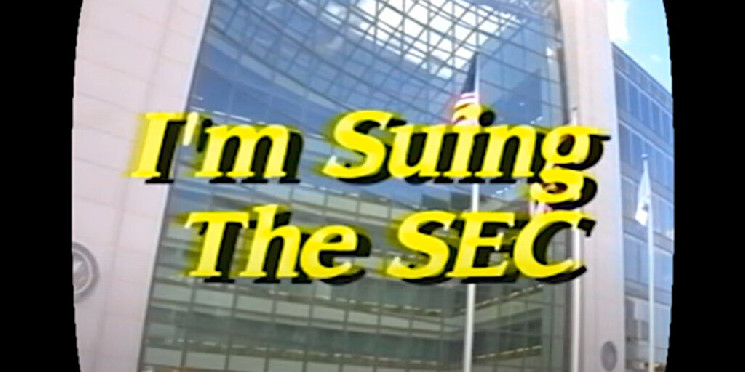
Mann even commemorated the occasion with a new song (mintable as an NFT, of course) titled “I’m Suing the SEC.”
“Like, I didn’t grow up with a distant dream… of someday suing a government agency,” the upbeat anthem goes. “But there’s this rogue regulator who’s been up to no good… Doing his very best to try and mess with my livelihood.”
Fundamentally, Frye believes, there is a gaping logical hole in the SEC’s approach to NFTs. For decades, as Frye has long emphasized, the regulator has refrained from regulating the art market, even pieces routinely bought as stores of value, and sold in series of identical or near-identical derivatives.
So what is it about putting such art pieces on-chain that would automatically make them securities? And why would only some NFT projects fall under the SEC’s authority, then, but not others?
“I don’t think they want to say the quiet part out loud, which is: ‘We can regulate whatever the fuck we want,’” Frye said.
The law professor is thus quite excited at the prospect of finally forcing the SEC to explain the contours of its NFT policies in federal court.
“I think that’s going to be a really difficult thing for them to do,” he said.
If this week’s lawsuit represents a thrilling and long-overdue intellectual battle with the American state to Frye, its meaning is somewhat more existential to songwriter Mann.
“I want to know, for myself and for everyone that I know trying to make a living by making NFTs, that what we’re doing is not going to draw Sauron’s eye,” Mann said, name checking the all-seeing, all-destroying, all-powerful villain of The Lord of the Rings fame.
The lawsuit has no guarantee of offering some conclusive end to the NFT regulation question, both readily admit. That may only come with concrete legislation or a judgment by the Supreme Court.
Regardless, the professor and the musician are both feeling catharsis—though for slightly different reasons—at the prospect of finally putting the SEC’s seemingly contradictory stance on NFTs on trial.
“This is a really deep, profound, existential, ontological problem that has to be resolved one way or another,” Frye said. “I’m not saying I know what the right answer is. I’m just saying there has to be an answer.”