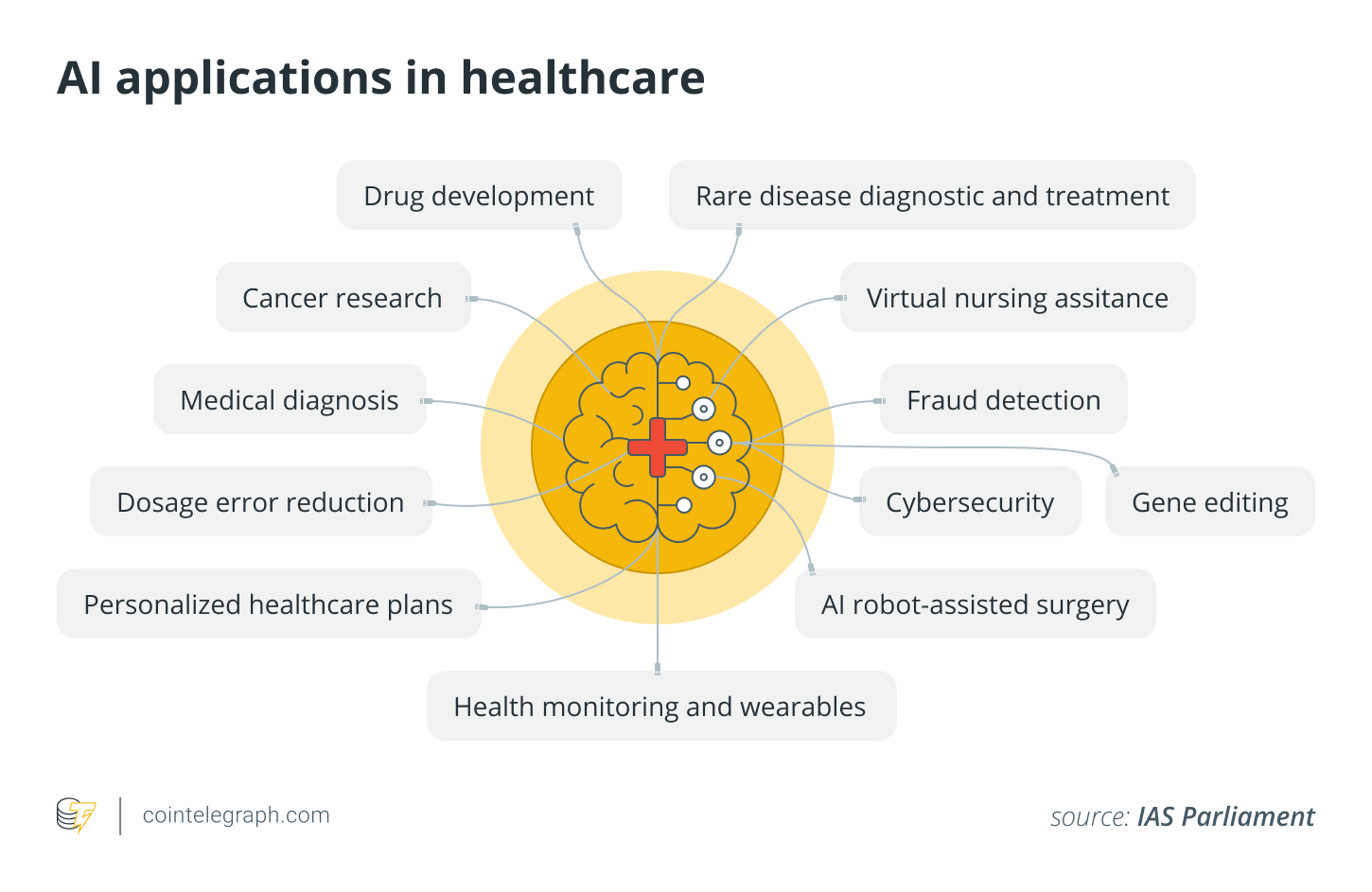
Artificial intelligence (AI) is no longer a concept confined to science fiction; instead, it has become a part of our everyday lives, driving advancements in various sectors, from finance to transportation. However, one of the most profound impacts of AI is being felt in the healthcare industry.
AI’s ability to learn from vast amounts of data and make predictions is changing healthcare by enhancing patient care and medical research. From diagnosing diseases with remarkable accuracy to managing patient care and pioneering personalized medicine, AI is not just an auxiliary tool for medical professionals but a game-changer in the healthcare landscape.
Moreover, the ongoing integration of AI in healthcare is not merely a trend but a significant shift toward more efficient, patient-centric care. It is transforming how we understand diseases, develop treatments and deliver care, thus reshaping the future of healthcare.
A new frontier in disease detection
AI has shown immense potential in disease diagnosis, particularly in radiology. Studies have demonstrated that AI systems can now match or even outperform radiologists in diagnosing certain conditions using chest X-rays.
Once trained using a large data set of X-rays, AI models can identify a range of diseases — including lung cancer and tuberculosis — with a high degree of accuracy. Speaking on the subject of AI-based disease detection, Dimitry Mihaylov, co-founder and chief science officer for AI-based medical diagnosis platform Acoustery, said:
“AI algorithms can analyze medical images such as X-rays, MRIs, and CT scans to detect abnormalities and assist in diagnosis. Another huge domain is drug discovery and development. AI is revolutionizing the process of drug discovery by analyzing vast amounts of biological and chemical data.”
Moreover, AI has been instrumental in the ongoing fight against COVID-19. AI algorithms formulated after 2020 have been deployed to predict the likelihood of a patient developing severe symptoms, helping doctors prioritize care for those most at risk. AI models have also been used to analyze CT scans and identify signs of COVID-19 infections at their onset, providing a valuable diagnostic tool — especially in regions where testing capacities remain limited.
AI’s potential extends beyond radiology and infectious diseases. For example, in the field of ophthalmology, a branch of medicine concerned with studying and treating eye disorders and diseases, AI technology has been used to diagnose diabetic retinopathy, a common cause of blindness. In this regard, a study demonstrated that AI systems could diagnose diseases simply by evaluating retinal scans with an accuracy comparable to human experts.
In cardiology, AI has been used to predict heart attacks and strokes. Experts have shown that AI diagnostic platforms can now detect life-altering medical events up to five years in advance, outperforming traditional prediction models.
Is the dawn of personalized healthcare upon us?
Over the last half-decade, AI has also started to revolutionize patient management. In this regard, machine learning (ML) algorithms — a prominent application of AI — can analyze vast amounts of patient data to predict individual health risks and suggest personalized treatment plans.
This approach can lead to effective and efficient care, improving patient outcomes while reducing healthcare costs. There is data demonstrating that ML models can predict patient mortality, re-admission rates and length of stay, among other outcomes, with high accuracy.
Source: Animoca still bullish on blockchain games, awaits license for metaverse fund
AI is also helping reduce the administrative burden on physicians, freeing them to spend more time on patient care. To this point, the technology can streamline the process of clinical note-taking, reducing physician burnout and improving patient outcomes.
Personalized medicine, which tailors treatment to the individual patient, is another area where AI has the potential to make a significant impact. By analyzing genetic data and other patient information, AI can help identify the most effective treatments for each patient, improving outcomes and reducing side effects.
Mihaylov claimed that AI is a key driver for personalized medicine: As AI algorithms can analyze individual patient data — including genetic information, medical history and lifestyle factors — they can provide personalized treatment recommendations to improve treatment efficacy, minimize adverse effects and optimize patient outcomes.
“As an example, proper asthma treatment is efficient only if we make treatment and traction personalized. That could not be done before everybody had a mobile device, and since AI is powerful enough to process all of an individual’s data, such individualistic treatment is now becoming a living reality,” he said.
Supervising AI in healthcare
As AI continues to permeate the healthcare sector, it’s becoming increasingly crucial for healthcare providers to comprehend the risks associated with AI and the subsequent need for oversight.
According to Thomas O’Neil, managing director at Berkeley Research Group and ex-Cigna chief compliance officer, AI-based medical reimbursement models are being designed to leverage large volumes of data to predict expected payments. However, this approach raises several ethical considerations, including informed consent to use data, safety and transparency, algorithmic fairness and biases, and data privacy.

O’Neill also pointed out that while AI can streamline claims processing and reimbursements — thus improving accuracy, enhancing workflow quality and mitigating the risk of errors in patient information entry or pre-authorization claims — these areas require careful oversight. In his view, a board or governing body responsible for overseeing such strategic initiatives needs to be deployed.
Mihaylov believes that some of the most pressing challenges when it comes to supervising AI systems in healthcare are data privacy and security. “Healthcare data contains sensitive patient information, so it is essential to work with lawyers to ensure that everything is done in the correct manner,” he noted.
He added that integrating AI into healthcare systems presents multiple challenges, many of which extend beyond the realm of pure governance alone.
Source: Google Cloud furthers Bitcoin Lightning ambitions with Voltage partnership
For starters, sourcing high-quality data is a big challenge for medical organizations since AI models require large amounts of information for training and validation. And because healthcare data is often fragmented, unstructured and stored in different formats across various systems, this issue must be examined more carefully.
The future of AI in healthcare
While the potential of AI in healthcare is immense, there are also certain challenges to overcome. However, with ongoing research and development, and appropriate regulation, AI stands to play an increasingly important role in the global healthcare sector. Therefore, as more and more people transition toward using decentralized technologies, it stands to reason that the influence of AI — from disease diagnosis to patient management and personalized medicine — will only continue to increase.
Moreover, as the technological landscape continues to evolve, we can expect AI to deliver even more innovative solutions to the challenges facing the healthcare market, thereby improving patient care and outcomes.
Collect this article as an NFT to preserve this moment in history and show your support for independent journalism in the crypto space.