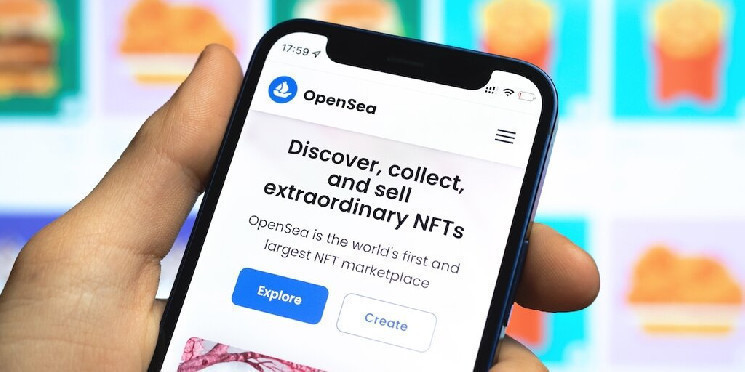
OpenSea, the leading NFT marketplace during the 2021-2022 bull run, is now in the middle of a transition to a new “OpenSea 2.0” launch with a much leaner team following layoffs last fall. And we’re starting to understand what that will look like as the once-dominant marketplace considers its evolution and next steps.
On Tuesday, OpenSea announced support for the ERC721-C Ethereum NFT token standard, which was developed by video game startup Limit Break and enables project creators to enforce royalty fee payments on secondary market trades.
It’s the latest move by OpenSea to adapt to changing tides in NFT royalty enforcement over the last year and a half, as rival marketplaces shunned the once-standard creator fees.
The marketplace had said in late 2022 that it would continue to enforce royalties following creator pushback and launched a protocol to try and protect royalties on new collections. However, OpenSea ultimately moved away from the operator-filter protocol and sunsetted support for it at the end of February. ERC721-C represents another run at the royalty problem.
We’re excited to announce that creators can now use ERC721-C from @limitbreak to set and enforce their own creator earnings on OpenSea.
What is ERC721-C? ERC721-C is a standard that enables creators to implement programmable and enforceable creator earnings on-chain. It also… pic.twitter.com/iGAuGsjNid
— OpenSea (@opensea) April 2, 2024
ERC721-C support was enabled by the recent launch of OpenSea’s Seaport 1.6 protocol update, CEO and co-founder Devin Finzer told Decrypt, which let creators set conditions before an NFT can be transacted—in this case, honoring royalties.
“Generally, we’ve been interested in new ways to support creator earnings,” Finzer said. “Seaport 1.6 was made possible by the Dencun upgrade to Ethereum, so that was something that allowed us to implement this functionality in this particular way.”
OpenSea laid off about half of its staff in November following a dramatic shakeup among NFT marketplaces earlier in the year, as upstart rival Blur overtook OpenSea thanks to incentivizing trades via its own token. An OpenSea representative could not confirm the size of the company’s team by the time of publication.
Finzer said that the slimmer company has been reimagining the NFT marketplace experience, with plans to combine the OpenSea and OpenSea Pro platforms into a single interface, develop “a really streamlined and smooth onboarding experience for users,” and to deploy custom interfaces for categories like gaming and ticketing.
“We’re really overhauling the product in a pretty big way,” said Finzer. “So this means a real visual refresh of the product and an infrastructure refresh.”
The shift comes at a time in which OpenSea’s market share has faded to a single-digit percentage, with less than 3% of cross-chain trading volume share over the last per data from Tiexo—and under 7% over the past 30 days. The reigning champ of late is Magic Eden, which has launched a rewards program in parallel with an upcoming “NFT” token airdrop.
OpenSea has long resisted the idea of launching its own token, as rivals like Blur and LooksRare have done in the past. It’s been the biggest burning question around the marketplace for years, particularly as competitors have gained steam by debuting their own tokens or rewards programs tied to future token drops.
Asked if he thinks token incentives like that are sustainable, Finzer wouldn’t spill on whether the marketplace will consider creating and dropping its own ecosystem token. But he acknowledged that token incentives are “really exciting” and can be an effective way to align users with the protocols they frequent.
“In general, across crypto, this idea of having users participate and be incentivized and aligned with applications is really exciting,” Finzer told Decrypt. “And that’s something that we’ve seen all over the place in crypto, really since the dawn of Bitcoin and Ethereum is that there’s more participation—there’s more skin in the game when it comes to usage of crypto products.”
“I think that we’re just seeing that trend play out more and more across crypto, and it’s really exciting to see.” he added. “But no, nothing to share on our front with regards to that.”
Finzer offered a similar reply in terms of whether OpenSea plans to support Bitcoin Ordinals, the NFT-like protocol that has helped Magic Eden gain a leg up over all other rivals in recent weeks. He’s intrigued by the way that Ordinals have captured the attention of Bitcoiners, however, but says that recent Ethereum ecosystem developments have also been compelling.
“No announcement yet on that front either,” Finzer said of the Bitcoin assets. “But I certainly think that, in general, the Ordinals ecosystem is pretty interesting. It’s really engaged the Bitcoin community.”
Bitcoin Ordinals trades tend to be higher-value, however, and Finzer said that low-cost transactions via Ethereum layer-2 networks like Base are a bigger focus for OpenSea at the moment.
With layer-2 fees falling sharply after the Dencun upgrade, they’re seeing sizable demand on Base and expect that scaling networks can better support use cases like gaming. Making it easy to move funds across networks and transact is still a work in progress with layer-2s, he added, but he sees their emergence as a key step in bringing NFTs to the masses.
“Gas costs need to go down, right? And the exciting thing is that now they have gone down dramatically. It’s just a matter of stitching things together and making the user experience really good for users today,” he said. “Our vision has always been that we need to dramatically lower the costs and scale blockchain so that we can support all sorts of use cases.”