- Runes have been designed as a new way to mint fungible tokens on the Bitcoin network.
- Since its launch, 10,739 Rune tokens have been created.
Daily transactions involving Runes on the Bitcoin [BTC] climbed to their highest level on the 23rd of April, according to data from Runes Alpha.
On that day, 802,977 transactions involving Runes were completed.
So far, 52,365 Runes transactions have been executed, bringing the total number of transactions to 2,560,005 since it launched on the 20th of April following Bitcoin’s fourth halving event.
Runes take up space on the Bitcoin network
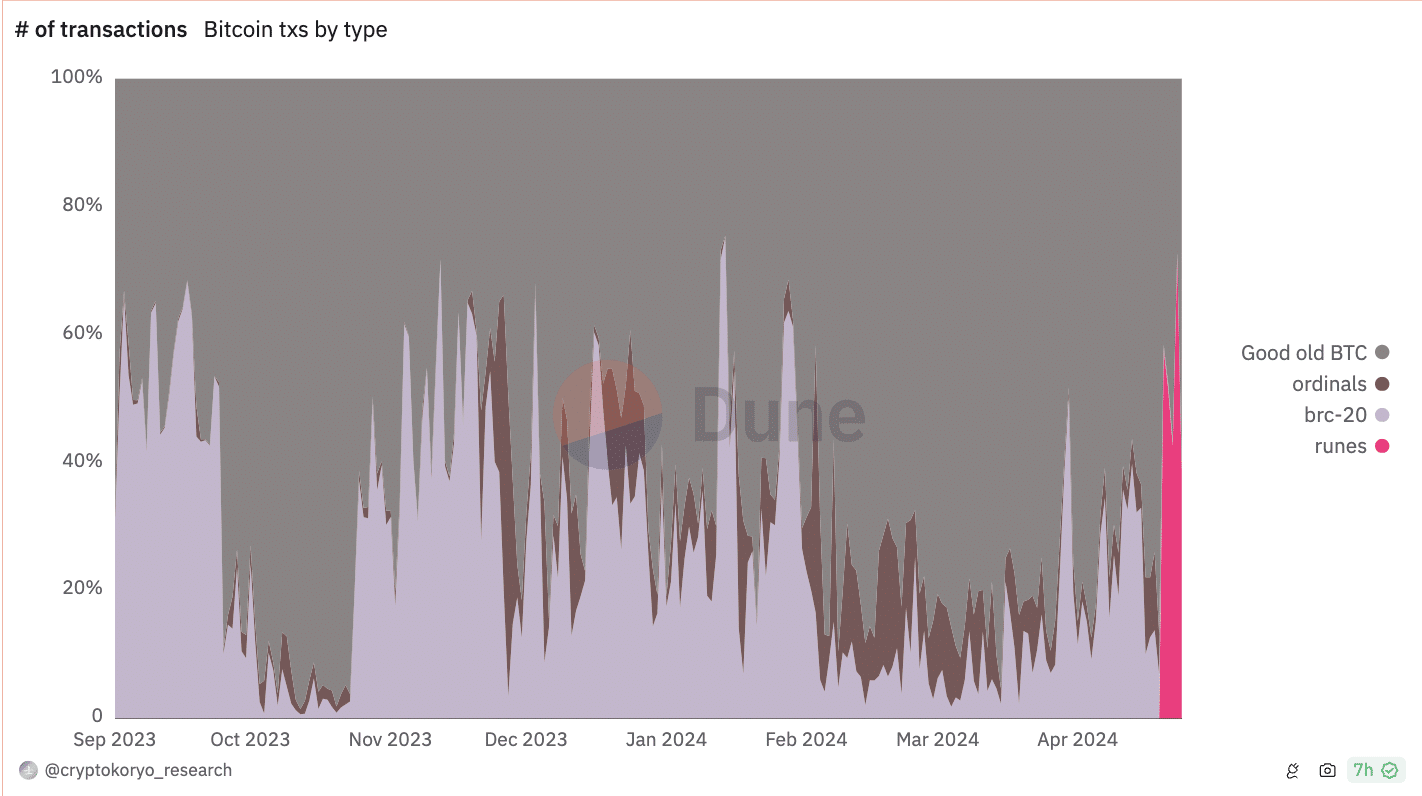
According to a Dune Analytics dashboard prepared by Crypto Koryo, transactions involving Runes have been the most significant on the Bitcoin network since the 20th of April.
When the Runes protocol launched, it accounted for 58% of all transactions completed on the Bitcoin network. Transactions involving the sale of BTC represented 42% on the same day.
On the other hand, Ordinals and all other BRC-20 tokens on the layer one network recorded a combined 0.7% of all network transactions completed.
Due to the spike in Runes’ daily transactions on the 23rd of April, its share of the total transactions count on the Bitcoin network on that day climbed to 78%.
Per Dune Analytics data, on that day, transactions involving Runes exceeded those that were completed towards the sale of BTC on the network by 45%.
Source: Dune Analytics
Upon launch on the 20th of April, transactions involving Runes made up 57% of all fees paid on the Bitcoin network, pushing the blockchain’s total fees to an all-time high of over $80 million.
On that day, the average transaction fee on the network reached a high of $128, surpassing the $30 peak experienced when interest in Ordinals first spiked.
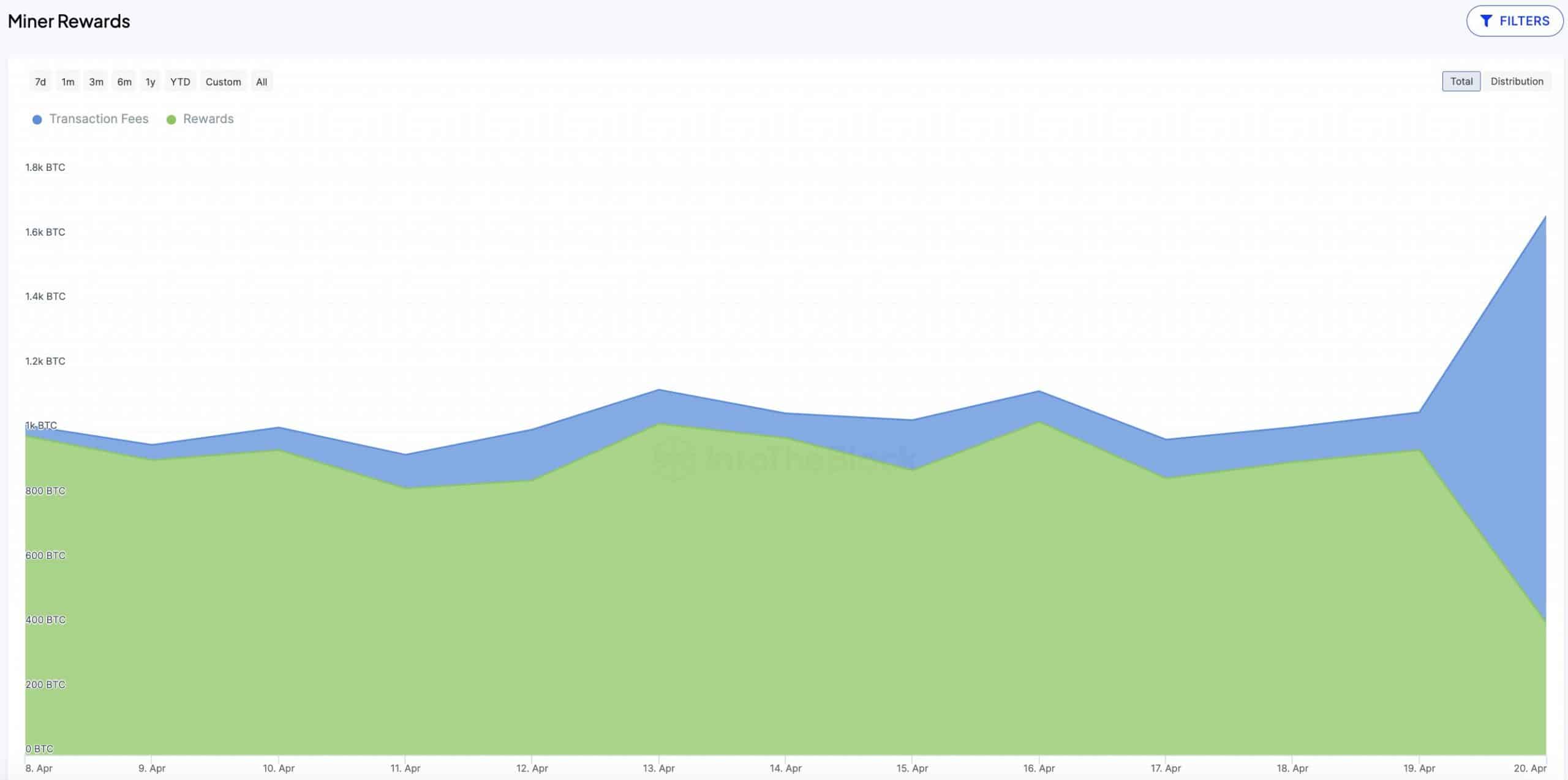
As a result of the surge in transaction fees on the Bitcoin network, miner revenue skyrocketed. This occurred despite the fact that inflationary rewards had dropped by 50% post-halving.
Per IntoTheBlock’s data, miners’ revenue exceeded $100 million on the halving day.
Source: IntoTheBlock
In comparison, on the 20th of April, fees paid to process BTC sales transactions accounted for just 38% of all fees paid on the network.
Decline in new etching
The Runes Protocol supports three kinds of transactions: etching, minting, and transferring. Etching allows users to create Rune tokens with set terms.
With minting, users can mint previously etched tokens, which they can transfer to different wallet addresses.
Despite the surge in Runes’ daily transactions, the number of new etchings completed has steadily declined since the halving. On the 20th of April, the count of Rune tokens etched totaled 2647.
However, this has since trended downward, and as of the 23rd of April, less than 1000 new Runes were created. Since its launch, 10,739 Runes have been created, according to data from Runes Alpha.
A new way to do things
Put simply, the Runes Protocol, created by Bitcoin Ordinals originator Casey Rodmarmor, is a new standard for creating fungible tokens directly on the Bitcoin blockchain.
The method of generating fungible tokens on the Bitcoin network was first made possible by introducing the BRC-20 token standard by a pseudonymous developer, Domo, in March 2023.
These assets grew in popularity, reaching a market capitalization of $1 billion by June of the same year. However, as the surrounding hype grew, they often led to congestion on the Bitcoin network.
A large number of unspent transaction outputs (UTXOs) were created, clogging the network.
For example, as previously reported, on 3rd December, the count of BRC-20 tokens minted rallied above 450,000.
This caused significant congestion on the Bitcoin network, as over 267,000 transactions remained pending for several hours before they were confirmed.
Due to this, the network’s mempool had a backlog. The surge in pending transactions caused the memory pool to reach 1.54 GB, exceeding its 300 MB capacity.
How does it work?
The Runes Protocol essentially adopts Bitcoin’s UTXO model and the OP_RETURN opcode, a special instruction within transactions on the network.
When a new Rune token is created, it is attached to a specific UTXO.
Information about the token, such as its name, divisibility, symbol, minting terms, amount, etc. are stored in the UTXO using the OP_RETURN opcode within the Bitcoin transaction.
This is done so the UTXO is marked as a Rune-carrying unit.
When a transaction is initiated to send a Rune token, it basically involves sending the UTXO within which its details have been encoded.
Is your portfolio green? Check out the BTC Profit Calculator
The transaction specifies how many Rune tokens (part of the UTXO value) are being sent and creates new UTXOs representing the remaining balance and the received tokens.
Through its design, Runes avoids the need for extensive token contract information on the Bitcoin network. This prevents unnecessary data presence, which often causes network congestion.