- Glassnode estimated about $70 billion in capital inflows into a Bitcoin ETF.
- Less Bitcoin would be immediately available for new investors.
The crypto market pinned its hopes on the potential approval of a Bitcoin [BTC] spot exchange-traded fund (ETF), which many analysts believe would be a turning point for the king of cryptocurrencies.
If greenlighted by the U.S. Securities and Exchange Commission (SEC), ETFs would expose BTC to a big pool of institutional investors in the traditional financial markets.
These changes could be expected
While the anticipation was peaking, a logical question that could be posed was how much of the Bitcoin market would be available for spot ETFs. How much new capital would it attract?
In a report, on-chain research firm Glassnode estimated about $70 billion in capital inflows into a Bitcoin ETF. Out of this, nearly $60.6 billion was supposed to flow from the stock and bond market, while about $9 billion from the gold market.
The calculations were based on educated assumptions about capital flows from mainstream financial markets.
The assumptions were made after factoring in ongoing challenges to these investment vehicles as well as Bitcoin’s growing “digital store of value” narrative.
The $70-billion figure seemed conservative when compared to estimations by some of the other analytics firms. Last month, CryptoQuant predicted capital inflows of $155 billion into the Bitcoin market upon clearance of the ETFs.
Supply crunch could trouble new investors
Apart from the demand side, Glassnode brought attention to the exposure of Bitcoin’s available supply to spot ETFs.
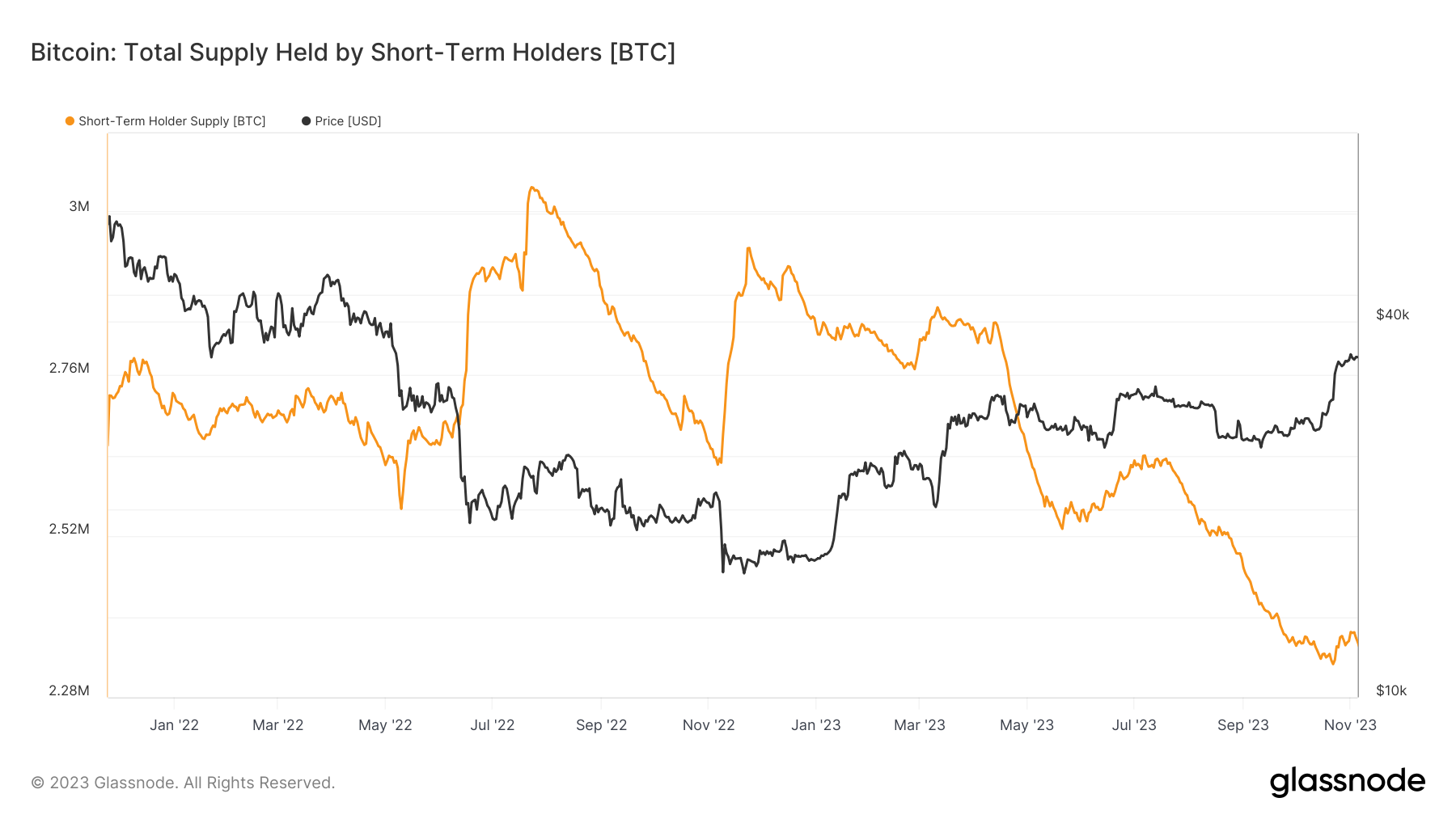
Short-term holders (STH), who are known to frequently buy and sell and are more sensitive to market swings, are seen as good indicators of liquid supply.
The short-term holder (STH) supply was at multi-year lows at the time of writing. This implied a marked reduction in Bitcoin’s tradeable supply.

Source: Glassnode
Another way to look at the supply squeeze was through the illiquid supply indicator. The illiquid supply was nothing but BTCs locked up in wallets that have a poor history of spending.
As seen from the graph below, the illiquid supply has been steadily increasing over the last two years.
In contrast, liquid supply, which has a much higher possibility of getting transacted, fell significantly in the same time.
To make the long story short, less Bitcoin would be immediately available for new investors.

Source: Glassnode
Moreover, if the limited supply fails to keep pace with new demand from spot ETFs, Bitcoin could face higher market volatility, Glassnode added.
Bitcoin market becoming more sensitive to investments
It was also essential to study the Bitcoin market’s sensitivity to influx of new capital. The Realized Cap acts as a reliable tool in this analysis.
Realized cap values an asset based on the price of each of its coins when they last moved, instead of their market value. You can think of it as a measure of invested capital.
Usually, when new capital enters the market and investors bag Bitcoins at a higher price, the realized cap witnesses an increase.
Clearly, the conventional market cap would increase at a rate greater than realized cap.
The sensitivity is therefore the ratio of realized capital to market cap change. When the ratio is low, it means that the market is highly sensitive.
Small amounts of invested capital would cause significant change in the market cap. Conversely, a higher ratio will require larger investments to drive Bitcoin’s market value

Source: Glassnode
At the time of writing, the ratio was $0.085. This meant that just $0.085 in capital investments was needed to cause a $1 change in market cap, indicating a highly sensitive market.
However, the real test would come in the aftermath of the spot ETF launch.
Is your portfolio green? Check out the BTC Profit Calculator
Bitcoin climbed above $37,000 in the last 24 hours, shrugging off Binance-related FUD. The coin was comfortably placed at $37,341 at press time, up 2.27% from the same time last day, as per CoinMarketCap.
The market sentiment leaned towards greed as per latest updates from the Bitcoin Fear and Greed Index. This implied more buying could be seen in the days to come, potentially driving prices higher.