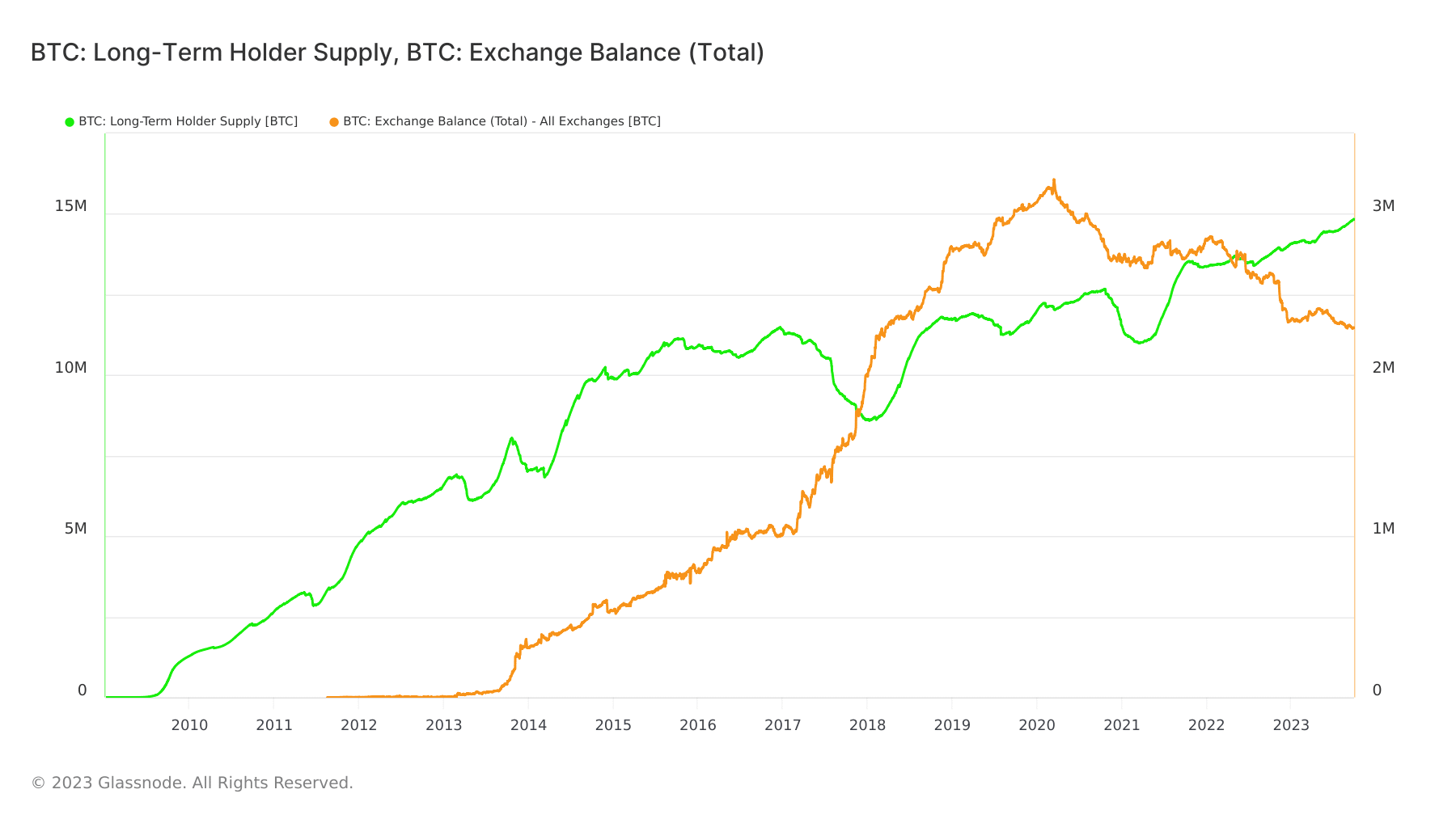
- Long-term holders controlled the major chunk of Bitcoin’s supply.
- Bitcoin’s supply cap and decentralized nature worked in its favor.
Bitcoin’s [BTC] relative stability and resilience in the face of several market challenges has led to a dramatic shift in sentiment surrounding the king of digital assets.
Read Bitcoin’s [BTC] Price Prediction 2023-24
Bitcoin: The store of value
No longer appealing to traders who used to flip the coin for quick profits, Bitcoin has become the new savings option for seasoned investors.
According to on-chain analytics firm Glassnode, Bitcoin’s reserves on centralized exchanges shrunk to depths not seen in the last five years. A major chunk of them were locked up in the self-custody of long-term holders (LTH), as evidenced by the steady increase in their stashes.

Source: Glassnode
Long-term holders typically possess high risk tolerance. This group takes advantage of the bear market to increase their holdings of fundamentally strong assets and sell them into bull market strength.
Therefore, the sustained increase in HODLing implied that these players were betting on Bitcoin as a store of value or a hedge against inflation. But is the confidence justified?
Bitcoin’s deflationary factor
A recent report by crypto asset manager CoinShares tried to find merit in the aforementioned argument. Undoubtedly, one major factor that could work in Bitcoin’s advantage was its scarcity.
As per economic principles, the scarcer an asset is, the more value it would acquire over time. Bitcoin’s supply has been hard-capped at 21 million, which means that once the limit is reached, no more coins will enter into the hands of the public.
The issue with traditional finance, as consistently flagged by Bitcoin proponents, was that a central authority controlled the issuance of the currency and hence the monetary supply. Global central banks manipulate borrowing rates to boost or restrict economic growth, depending on the state of the national economy.
For example, when the economy is sluggish, the central bank would cut the cost of borrowing. This incentivizes spending and discourages saving, as a person’s ability to avail credit is boosted significantly. As a result, domestic consumption spikes and more money flows into the economy.
But while moderate inflation is good, high levels create another set of problems for the economy. High inflation reduces the purchasing power of the common man. This meant that for the same amount of money, the number of goods and services available to them would be significantly reduced.
Moreover, during periods of high inflation, the national currency depreciates against currencies and the U.S. Dollar (USD).
However, in the case of Bitcoin, the hard cap of 21 million is encoded in the source code and enforced by nodes on the network. As a result, any arbitrary adjustments to its supply or tokenomics were deemed out.
The scarcity feature thus puts Bitcoin in the league of time-tested inflation hedges like Gold. Like Bitcoin, the precious metal is a limited resource and has acted as a safe haven during periods of economic stagnation.

Source: CoinShares
Bitcoin ticks these boxes as well
The other factor giving Bitcoin the upper hand in “digital gold” narrative is its durability. In its fourteen years of existence, the proof-of-stake blockchain has experienced an uptime of a staggering 99.98%.
In fact, the last time the network went down was about ten years ago. Hence, the network stability boded well for Bitcoin’s mainstream adoption.
Furthermore, Bitcoin is portable, in the sense that it’s stored in a digital wallet and can be used anywhere. The ease of transporting and the convenience made the king coin an attractive savings option.
Delays on spot ETFs annoy participants
Bitcoin climbed above $27,000 for the first time in a week, settling at $27,051 at the time of writing. The crypto’s 2.32% rise in the 24-hour period came alongside a slight jump in the U.S. stock market.
Other crypto-specific elements that could be contributing to the growth were unclear as of press time.
Is your portfolio green? Check out the BTC Profit Calculator
Meanwhile, the United States Securities and Exchanges Commission (SEC) delayed its decision on spot Bitcoin ETFs yet again. Recall that TradFi giants like BlackRock and Invesco submitted applications for Bitcoin ETFs in June.
However, the regulator postponed a decision in late August when the first deadline approached. The SEC has a maximum of 240 days to approve or deny an ETF from the date of the filing.