Tokenized real world assets such as homes and private credit are a trending topic in the blockchain technology space, seemingly poised to become the next major narrative.
Earlier this month, a handful of companies in the industry banded together to form the Tokenized Asset Coalition (TAC), including Aave, Circle and Coinbase. Beyond creating educational content and building the necessary infrastructure to bring different types of assets on-chain, the coalition is also looking at developing relevant, compliant principles to drive the adoption of blockchain technology.
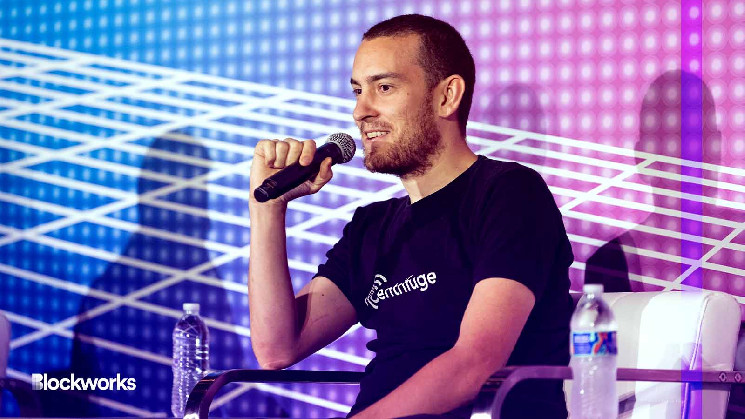
Blockworks sat down with Centrifuge founder Lucas Vogelsang at Permissionless II to learn about some of the necessary standards and regulatory hurdles such as know-you-customer (KYC) laws that need to be developed in order to bring tokenized assets onto the blockchain.
Blockworks: Could you tell me a little bit about how the tokenized asset coalition came to be and what it is trying to achieve?
Vogelsang: In 2018, there was this telegram group called “DeFi,” just decentralized finance, and it was really just a group of people looking at how to build financial products on-chain. At that time we barely had any crypto infrastructure, but the idea was that if you could create a token, and that token could be used in your DeFi protocol, and it becomes composable then you are building this new financial system.
Those people coming together and working on it just sped up the industry so much. One of the things that came out of that was DeFi Summits, for example. I saw firsthand how much the financial system is an ecosystem of many different participants and how you make it so much faster if you improve collaboration.
With TAC, what we’re trying to build is a marketplace or a whole ecosystem. The better we can standardize and work together, the faster the whole industry will reach an escape velocity and actually be able to compete.
Blockworks: What are some standards the TAC is looking into?
Vogelsang: I think KYC will be one of the standardizations that will come sooner or later. KYC credentials today aren’t really portable, and real-world asset DeFi will have to be KYC’ed and we will have to figure out how we actually work together on this.
Another one that I’m personally very interested in, and not really an active TAC project, is the 4626 tokenized vaults standard. If you think about most of these real-world asset pools, the problem is that many of them are incompatible with 4626 because 4626 is atomic. So, if you want to redeem shares, in the same transaction, you immediately get the underlying collateral or pool asset back, but this is not the case for RWAs. So we’re figuring out a way to see if we can come up with an extension that is more compatible with RWA projects so that if you want to provide liquidity or invest in any of these kinds of things, you can do so.
Blockworks: What is the value of having RWAs on-chain?
Vogelsang: The biggest value prop of RWAs, well I think there are two. There’s making the creation of these assets more efficient because you have instant settlement, a single source of truth on-chain that different service providers can use and you don’t have to send spreadsheets back and forth.
The other thing that is part of this whole RWA narrative for me is creating better market infrastructure. So once you have these assets on-chain, you can trade it more efficiently, you can borrow against it in an automated way. But you have to have to start with the tokenization part because, without these assets, there’s nothing to do.
Where this journey is going now, and this is where it gets exciting, is when you have 10x improvement over [traditional finance]. Ultimately, people don’t care about having these assets as a token if it doesn’t give them a better experience. If you just save a little bit of fees per year because the tokenization process is a bit cheaper than the [traditional finance] securitization process, sure that’s cool, but it’s not nearly as cool as if you can take an asset today that is illiquid, and you buy a tokenized version of it that’s liquid, because the market infrastructure is actually better on-chain and more efficient.
Blockworks: Could you tell me a little more about these illiquid assets in the real world that you think can be liquid on-chain? Would it be something like properties or houses?
Vogelsang: There are a lot of people in the crypto native world experimenting with marketplaces for non-fungibles, effectively, making a house liquid requires the same thing — we need to figure out a way for a liquid market to exist for non-fungible assets, real-world assets, but I think that is going to come later because it’s still a pretty hard problem.
If you look at fungible assets, such as private credit, the reason why it’s called private credit is because it’s not publicly traded. It is not an open public market because those assets are too hard to make liquid on the New York Stock Exchange.
If we can build a more efficient market infrastructure for these assets, we can turn them from private credit assets to public credit assets. All of these assets have a huge illiquidity premium right now because they are more expensive to finance. So when you can take these assets that are too small or too complicated to make liquid, and you move it to the right on the spectrum, that’s when you will start building something really powerful because now all these assets become liquid.
That’s why when I think of standardization efforts, focusing on creating the infrastructure needed for that to happen is really the biggest unlock for real-world assets.
This interview has been edited for brevity and clarity.